
 WhatsApp
Resisting Without Violence in Miami-Dade: Charges and Defense
A resisting-without-violence charge can turn a traffic stop, street encounter or other interaction with police into a criminal case. The officer's description is the starting point for a defense review, not the final answer about whether a crime occurred.
Valiente Law represents people facing criminal charges in Miami-Dade County. We can review what the officer was doing, what you allegedly did, and what the recordings and other evidence show. If this is your first arrest or you are not a U.S. citizen, raise those concerns before deciding how to resolve the case.
Call 305-764-5460 or request a free, confidential consultation. Se Habla Español.
What does resisting without violence mean in Florida?
Section 843.02, Florida Statutes, addresses resistance, obstruction or opposition to a covered officer or other authorized person carrying out legal process or lawfully performing a legal duty, without offering or doing violence to that person.
People often call this “resisting arrest,” but an arrest does not have to be underway. The charge can concern another legal duty. A case review should identify the specific duty and the conduct said to have interfered with it, rather than rely on the shorthand label.
What does the State need to prove?
The prosecution must establish the required elements beyond a reasonable doubt. A defense review asks:
- What specific act allegedly resisted, obstructed or opposed the officer?
- Was the officer executing legal process or lawfully carrying out a legal duty at that time?
- Was the person an officer or another person covered by the statute?
- Did the accused know the person's official status?
The evidence and applicable instructions matter. A police report that uses the word “resisted” does not replace proof of what happened.
Why the sequence of events matters
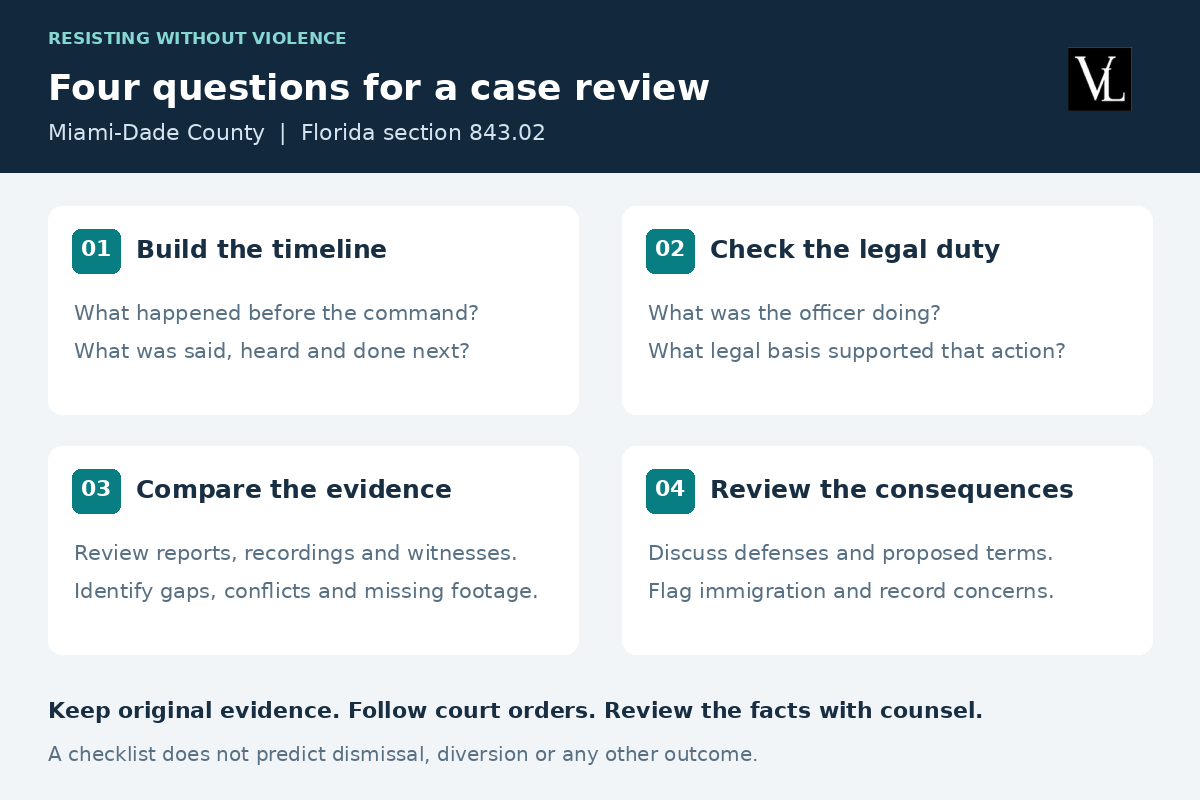
Your lawyer should reconstruct the encounter in order: what prompted it, what the officer knew, what directions were given, and what happened next. A disagreement about the first few seconds can affect the analysis of everything that followed.
For example, a report may describe walking away, failing to follow a direction, or moving an arm during handcuffing. Those descriptions need context. Your lawyer should examine the legal basis for the encounter and command, the exact movement or words, timing, and whether the evidence supports the allegation.
Tell your lawyer about language barriers, hearing difficulties, pain, disability, confusion or medical treatment. These facts are matters to investigate, not automatic defenses. Do not assume that asking a question, being upset, or being physically present either proves or defeats the charge.
Evidence to preserve for a resisting-charge review
Keep your arrest or notice-to-appear paperwork, release conditions and court notices. Preserve original recordings, messages and photographs already in your possession without editing or deleting them. Make a private timeline for your lawyer while your memory is fresh.
Identify nearby businesses, vehicles or people who may have recorded the incident. Tell your lawyer promptly so preservation and lawful evidence requests can be considered. Useful materials may include body-camera footage, dash-camera footage, dispatch records, surveillance video, witness information and medical records.
Do not post a defense narrative online or contact anyone to influence their account. Follow court orders and let your lawyer handle appropriate evidence-related communications.
Can resisting without violence lead to jail?
Yes. Section 843.02 is a first-degree misdemeanor. The ordinary statutory maximums are one year in jail under section 775.082(4)(a) and a $1,000 fine under section 775.083(1)(d). These are maximums, not a prediction of your sentence. Higher fines are authorized in specified circumstances, and costs or other lawful conditions may be separate.
Probation can involve reporting and other conditions. Do not assume that every case carries a fixed probation term or that a first offense rules out jail. Review the actual proposed disposition and its requirements. Our Miami misdemeanor guide explains the broader misdemeanor process.
How is resisting with violence different?
Resisting with violence under section 843.01 is a separate third-degree felony involving offered or actual violence. Lack of an injury alone does not resolve which charge applies. The alleged conduct and applicable law need review.
Florida changed the related with-violence and use-of-force statutes through chapter 2026-144, effective June 16, 2026. The current text of section 843.02 still includes the lawful-execution requirement. Do not assume that the same analysis applies to both offenses or to incidents occurring on different dates.
This discussion is not permission to resist police physically. Section 776.051 restricts the use or threatened use of force against a known or reasonably apparent officer acting in good faith, including when the action is later found unlawful. Discuss an unlawful-stop or force issue with counsel rather than trying to resolve it through confrontation.
First offense: defenses, negotiations and diversion
A first case deserves a careful evidence review before any agreement. Depending on the record and procedural posture, counsel may evaluate a legal challenge, request that the prosecutor reconsider the charge, negotiate a resolution, or prepare for trial. No particular result follows just from having no prior arrests.
The Miami-Dade State Attorney's Office describes pretrial diversion as an alternative to prosecution, with charges dropped when an admitted participant completes the required conditions and remains arrest-free during participation. That description does not establish that every resisting charge qualifies.
Before accepting an offer, ask about eligibility, any plea or admission, classes, community service, financial obligations, deadlines and what happens if a condition is not completed. Obtain the actual written terms and confirm how completion will be recorded.
Noncitizens: check consequences before a plea or program
A Florida misdemeanor label does not settle the federal immigration question. Under 8 U.S.C. § 1101(a)(48), certain dispositions can count as convictions even when adjudication is withheld, if the required plea, finding or admission is coupled with court-ordered punishment, a penalty or a restraint on liberty.
Do not assume that no jail, a withhold, or a program described as diversion is automatically immigration-safe. Tell your defense lawyer about your status and immigration concerns before agreeing to a disposition. The exact charge, court record, proposed terms and individual circumstances should be reviewed with immigration counsel when appropriate. This page does not classify every section 843.02 disposition as either safe or deportable.
Frequently asked questions
Is resisting without violence a felony?
Section 843.02 is a first-degree misdemeanor. A related violence allegation or another charge can create separate felony exposure. Check the actual statutory section on the charging document.
Can I be charged if I never touched the officer?
Yes. Section 843.02 addresses conduct without offered or actual violence. The important questions include what the alleged obstruction was and whether the State can establish the required elements.
What if I was only arguing or asking questions?
The exact words, actions and circumstances matter. Counsel should compare the allegation with recordings and the legal duty being performed. Neither an officer's label nor a brief online description is enough to decide the issue.
Does dismissal of another charge automatically end this charge?
Do not assume so. Have counsel evaluate the resisting allegation and the legal basis for the officer's actions separately, including how the other charge was resolved.
Will diversion or dismissal erase the record?
Do not assume that every record disappears. Record relief has separate rules and processes, and relief affecting one repository may not clear court or local-agency records. Review the final disposition and ask about sealing or expungement for your particular record.
What should I bring to a consultation?
Bring your case number, charging and release paperwork, next court date, and any unedited evidence you already have. Write down potential witnesses, camera locations, the sequence of events and the consequences that concern you.
Discuss your Miami-Dade resisting charge with Valiente Law
A useful first step is to review the charge, court deadlines and available evidence. Contact Valiente Law about a resisting-without-violence allegation and the questions you need answered before making a decision.
Call 305-764-5460 or request a free, confidential consultation. Se Habla Español.
This page provides general information, not advice about a particular case. Outcomes depend on the facts and applicable law.
Posted in: Criminal